
ClarifySEO · 28 May 2026
What Baidu can tell us about where Google search is heading
Baidu has consistently moved faster than Google on search changes. Here's what China's search engine shows us about where Google is heading and what SEOs there are already doing about it.
No one can predict where search is heading with certainty. But predictions about complex systems rarely come from nowhere. They come from historical patterns, observable trends, and geographical variation. We look at where something has already happened to estimate where it might happen next.
That's what makes the Baidu comparison worth taking seriously. Baidu is not a crystal ball. It's a data point, one that happens to be further along the same trajectory Google is on, operating in a different regulatory and competitive environment that allowed it to move faster. If you want to understand where Google search is heading, it helps to look at where Baidu already is.
That's not a contrarian position. It's a pattern with a track record. Baidu has consistently reached certain stages of search evolution ahead of Google, partly because it operates in a more controlled environment with fewer legacy constraints, and partly because it has been under more direct competitive pressure from domestic AI rivals to move fast. What Baidu does today has a reasonable history of showing up in Google within a few years.
The historical pattern
Baidu built its own content ecosystem early: Baidu Baike, Baidu Zhidao, Baidu Tieba. These gave it a closed loop of authoritative sources it could weight heavily in results, years before Google began prioritising its own properties and Wikipedia-style references. And with mobile penetration in China exceeding 99%, Baidu was forced to make mobile the primary surface far earlier than markets where desktop remained dominant. Google didn't begin rolling out mobile-first indexing until 2018, by which point Baidu had been operating a separate mobile search product for years.
None of this is coincidence. Baidu operates in a market where it controls both the search engine and significant portions of the content layer. It can move faster because it doesn't have to negotiate with an open web the way Google does. Google's constraints are real. Twenty-five years of publisher relationships, advertiser dependencies, and antitrust scrutiny slow it down in ways Baidu doesn't face.
The result is that Baidu tends to arrive at certain destinations first. The question worth asking in 2026 is where it has arrived now.
Where Baidu is now
By October 2025, roughly 70% of Baidu's mobile search result pages contained AI-generated content. Google's AI Overviews, by comparison, appear on a fraction of queries. Baidu has already crossed the threshold where AI-generated answers are the default experience rather than a feature sitting alongside traditional results.
After DeepSeek's emergence in early 2025 forced Baidu to accelerate its AI integration, the ranking signals that had mattered for years shifted. Keyword density and backlink profiles became less important than semantic quality and authoritative sourcing. Sites that weren't citeable by ERNIE, Baidu's large language model, started losing visibility even when they were technically well-optimised, as documented by TNGlobal's analysis of Baidu's post-DeepSeek shift.
The most significant change is what search has become at a functional level. Traditional search retrieves documents and ranks them. AI search reasons over a question and constructs an answer, sometimes citing sources, sometimes not. For site owners, this distinction matters because the relationship between visibility and traffic has broken. Your content can influence an answer that millions of people read without a single one of them visiting your page.
What Chinese SEOs are doing differently
This shift has produced a measurable change in how SEOs operating on Baidu approach their work. The techniques are worth understanding not because you should copy them directly, but because they reveal what an AI-first search environment actually rewards.
Building consensus across platforms. The goal is for brand names, headquarters, and core product claims to be identical across Baidu Baike, Sogou Baike, and Baike.com. When AI models cross-check their reasoning, they find a consistent picture, and consistency reads as authority. Most Western SEOs optimise their own site and stop there. Chinese SEOs operating in an AI-heavy environment think about how their brand appears across every surface an AI might reference.
Publishing a unique data slice. If everyone says "the best time to post on Douyin is 6 PM" and you publish a case study proving "11 AM is better for B2B industrial leads," the AI will cite you as the nuanced exception. That citation is worth more than ten number one rankings. Generic content that agrees with everything else doesn't get cited. It gets absorbed into the consensus without attribution. (Search Engine Land's analysis of China's 2026 search ecosystem documents these tactics in detail.)
Optimising to be cited, not to rank. Ranking optimisation and citation optimisation are different goals that produce different content. The first asks how to get to position one. The second asks how to become the source an AI system reaches for when answering a specific question, which has less to do with keyword signals and more to do with being the most credible, specific, and original voice on a topic.
Google I/O 2026 confirmed the direction
If the Baidu comparison felt theoretical before May 19, 2026, it doesn't anymore.
At I/O, Google confirmed that AI Mode has crossed one billion monthly users and AI Overviews reach 2.5 billion monthly users globally. It announced generative UI (Search building custom layouts, interactive tools, and dashboards on the fly in response to a query) and information agents that monitor topics continuously without the user asking anything. The traditional search box was rebuilt for the first time in twenty-five years.
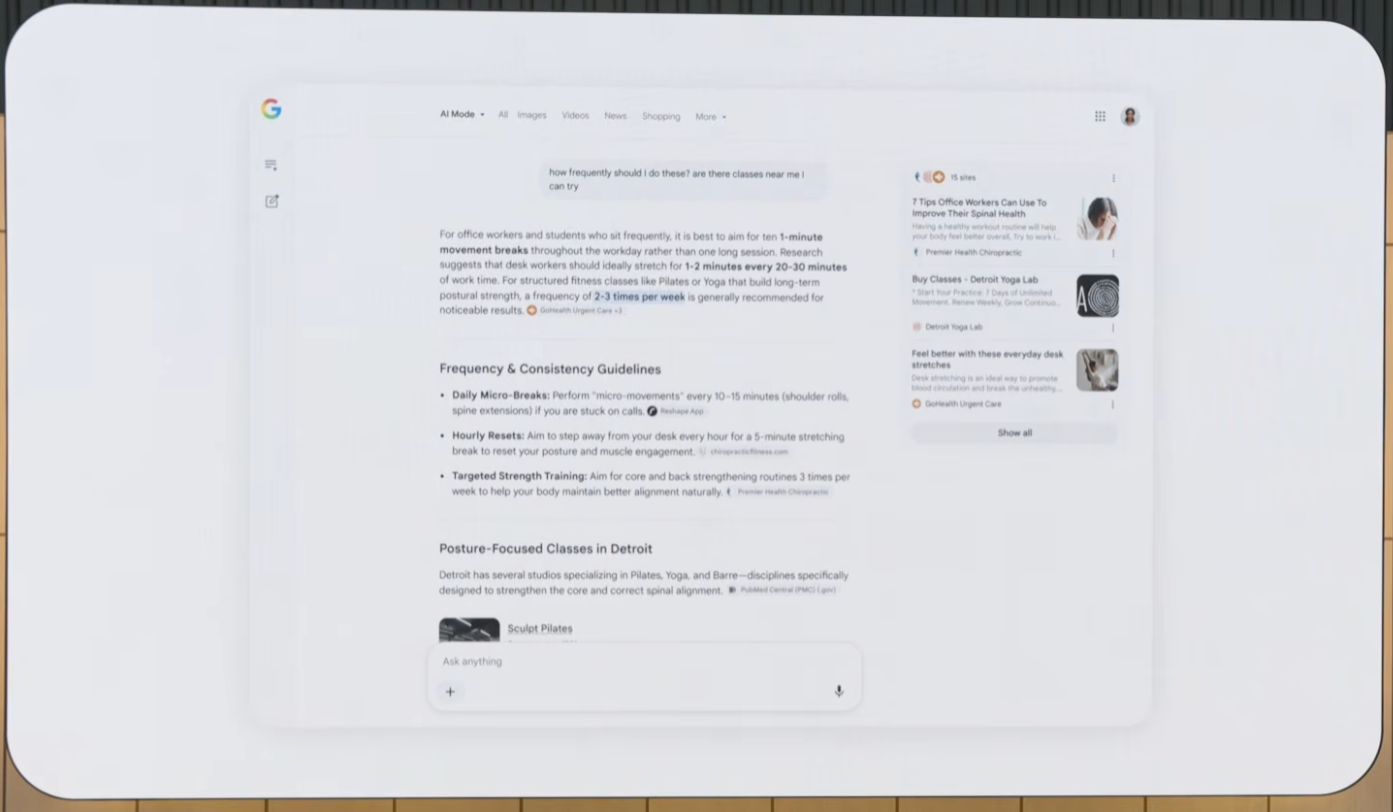 Google's new AI Mode search interface, demonstrated live at I/O 2026. Watch the keynote.
What makes this relevant to the Baidu argument is not the scale of the announcements but the direction they confirm. Baidu's trajectory, from keyword retrieval to AI reasoning, from ranking to citation, from pull to push, is now visibly Google's trajectory too. The gap between where Baidu is and where Google is has narrowed significantly in the past twelve months. Whether a site gets cited inside a generated interface will depend on factors Google hasn't disclosed yet, but the underlying logic is the same one Chinese SEOs have been adapting to for the past two years.
What this means for Google
Google is not Baidu, and the transition will not be identical. Google's economic model depends on clicks in a way Baidu's increasingly does not. Twenty-five years of advertiser relationships cannot be unwound overnight.
But the direction is now unambiguous, and the I/O announcements are not experiments. Google is moving from retrieval to reasoning, from links to answers, from a search box to an agent, and generative UI is rolling out to all users this summer at no charge.
On May 15, 2026, Google published its first consolidated guide on optimising for generative AI features in Search. The central message was direct: there is no separate strategy for AI search. The guide names the factors that earn citation inclusion: unique content that reflects genuine expertise, original research, or first-hand experience. Generic summaries that AI can generate itself add no citation value. That is precisely what Chinese SEOs operating on Baidu had already established through practice. Google has now said it explicitly.
There is one difference worth noting between Baidu's AI search and what Google is building: personalisation. Google has access to Gmail, Drive, Calendar, Photos, and two decades of search history. The I/O announcements confirmed that personal data is being integrated into AI Mode in 200 countries. Baidu's citation factors are based on public signals: consistency, authority, freshness. Google's will almost certainly layer personal context on top of those same fundamentals. Who gets cited may vary by user.
The underlying principles, however, are likely to follow the same logic Baidu's ecosystem has already established: consistent brand signals, original evidence, topical depth. The personalisation layer changes the distribution, not the foundation.
What to do with this
The honest answer is that nobody knows exactly how Google's AI transition plays out. What Baidu shows is one version of the destination: a search environment where AI answers are the default and citations matter more than rankings.
The content strategies that hold up in that environment are not exotic. They are the same things that have always separated genuinely useful content from content built to rank: original data, specific evidence, consistent authority signals across the web, and depth on narrow topics rather than shallow coverage of broad ones.
The difference is urgency. In traditional search, a site could build traffic on keyword-optimised pages for years before quality became a decisive factor. In an AI-heavy search environment, the window for that approach is shorter. Baidu's trajectory suggests it closes faster than most people expect.
See how your site is performing in search before the landscape shifts further.
Run a free audit and see exactly where you stand.